
Why does pushing the broken stub deeper make the repair bigger?
Because a stub that sits near the front of the lock can usually be taken out as it is, while one pushed further in ends up out of reach and often damages the parts around it. That can turn a simple extraction into replacing the whole cylinder.
Phones answered around the clock · free estimate
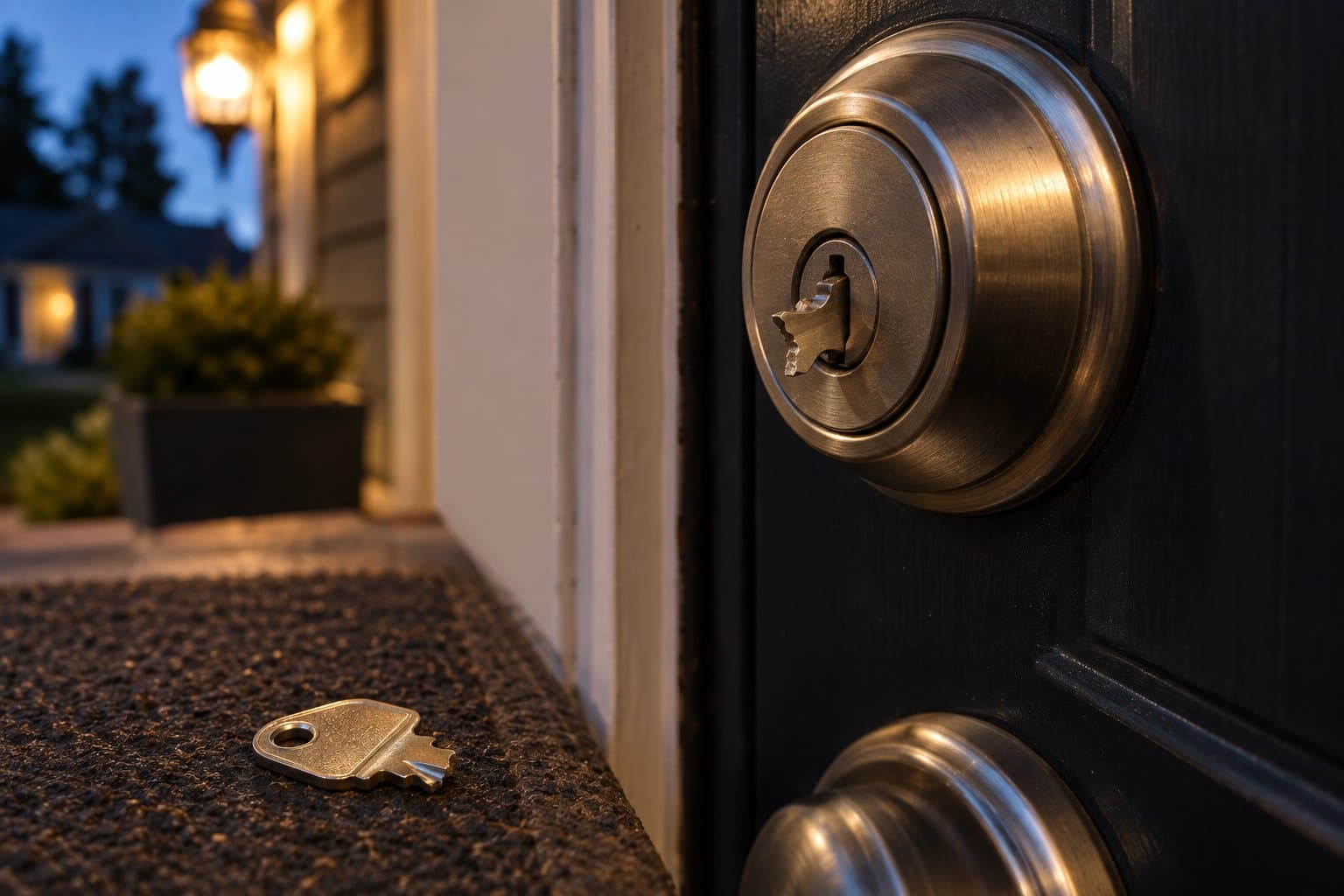
The nuance is that the stub is not always the real problem. If the keyway is already worn or chewed, the cylinder may need replacing anyway, but pushing the piece in yourself removes the chance that it would not.
Why it happens
A lock cylinder is a small, tight space. The keyway is cut to fit one key profile, and the parts inside are sized to fractions of a millimetre. A stub close to the face of the lock can be reached and removed without disturbing any of that.
Once the stub goes deeper, it can wedge against the internal parts, bend, or scratch the walls of the keyway. Each of those makes it harder to remove, and a damaged cylinder often cannot be saved. The job then moves from taking out a broken piece to fitting a new cylinder and cutting new keys for it.
Glue is the other thing that changes the outcome. Even a small amount in the keyway can leave a lock that cannot be recovered. Keys also tend to snap in cold weather and in worn cylinders, and a key that has been stiff for weeks was often giving a warning. A stiff lock is worth looking at before it gets to this point.
What you can check yourself
- Stop using the lockDo not try to turn it again or put another key in. Leaving the stub where it is keeps the job as small as it can be.
- Keep the other half of the keyIf you still have the part with the head, put it somewhere safe. A locksmith can often cut a new key from it.
- Do not use glueEven if the two pieces look as though they would fit back together, glue near a lock can ruin it.
- Note which lock it isCheck whether it is a front door, a deadbolt, a car door or an ignition, and whether you have a spare key. This helps the locksmith plan the visit.
- Check for anyone inside firstIf a child or an animal is shut inside the car or the home, call 911 before anything else.
When to call a locksmith
Call as soon as the key has snapped, particularly if the stub is below the face of the lock or you have already tried to move it. Call (866) 690-5848 and we will arrange a visit with an independent locksmith.
If the broken key has left you locked out, the locksmith will ask for identification and proof that you are entitled to enter the home, premises or vehicle before opening anything. A driver's licence with the address, a lease, a utility bill, or vehicle registration or insurance all work. The estimate is free. The locksmith looks at the lock, gives you the price, and work starts only once you agree to it. Locksmith licensing varies by state and sometimes by city, so check with your state or city if you want to know what applies where you live.
What the locksmith will do
- Remove the broken pieceThe locksmith takes the broken piece out of the lock and checks that nothing else is left behind.
- Check the cylinderThe cylinder is checked for damage. If the keyway is chewed, it is replaced rather than reused.
- Provide a new keyA new key is cut from the surviving half or from the lock itself.
- Lubricate and check the doorThe lock is lubricated and the door alignment is checked, so the same strain does not break the next key.
Related questions
- Can a key be removed if the stub is flush with the lock face?
- Often, yes, and that is the best case. A stub still reachable at the front of the lock is the easiest to remove. The locksmith can tell you after looking at it whether the lock can be kept.
- Will I need a new lock?
- Not always. If the cylinder is undamaged after the extraction, it can stay. If the keyway is chewed or the stub was pushed in or glued, the cylinder is usually replaced. The locksmith gives you that answer in the free estimate before any work begins.
- Can a new key be made if I only have half the old one?
- Often it can. A new key can be cut from the surviving half, or from the lock itself if there is not enough key left. Keeping both pieces helps.
- Why did my key snap in the first place?
- Usually wear. Worn keys and tired cylinders break more easily, and cold weather makes metal more brittle. A lock that has been getting stiff for weeks is a sign to have it looked at.
One call
Free estimate. The price is agreed before the work starts.
More from One Call Locksmiths
Or send us a message
Leave your details and what is going on, and someone from the team will call you back.
One Call Locksmiths arranges the visit; the locksmith does the work and gives you the price.