
Why did my key snap off in the lock with no warning?
Your key almost certainly broke from metal fatigue — thousands of small twists slowly weakened the blade until one ordinary turn was the one too many. The warning was usually there, but quiet: a key that had been getting stiffer, needed a wiggle, or had to be pulled out at a certain angle.
Phones answered around the clock · free estimate
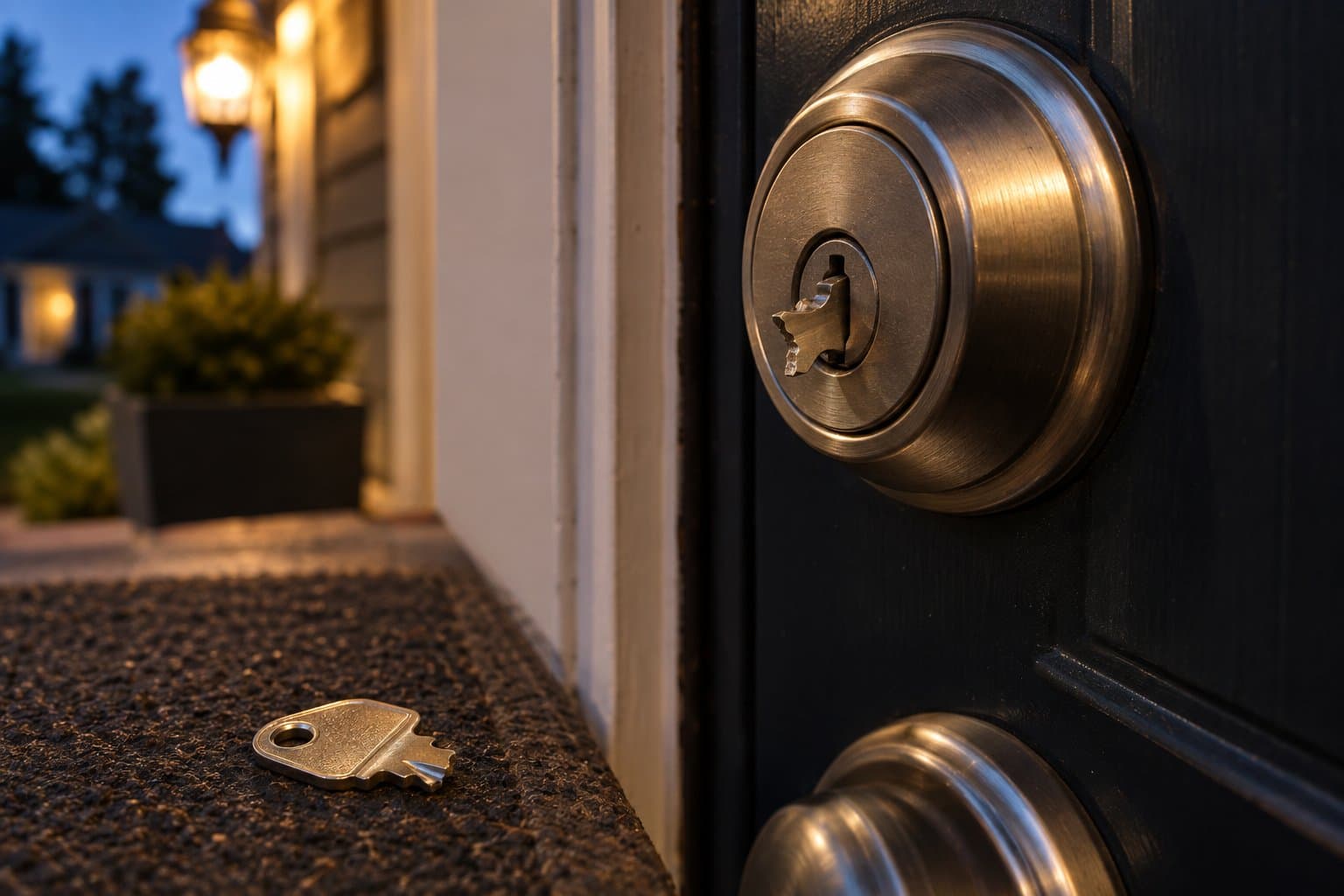
The other half of the story is the lock. A worn or dry cylinder makes you turn harder, and harder turning is what finally snaps a tired key. That is why a broken key is treated as a lock problem as much as a key problem.
Why it happens
Keys are soft metal by design — brass or nickel silver, so they wear instead of wearing out the lock. Every turn flexes the blade a fraction. After years that flexing leaves cracks you cannot see, usually at the shoulder where the blade meets the head, which is why the head often comes away clean in your hand.
Cold weather brings a lot of these breaks forward. Metal is less forgiving in the cold, lubricant inside the cylinder thickens, and doors swell or shift in their frames so the bolt drags. All three mean more force on the same tired key.
Copies are also more fragile than the original. A key cut from a copy of a copy sits slightly off, catches inside the keyway and takes more twisting to work — so it fails sooner. If the key had been stiff for weeks, that was the lock telling you this was coming.
What you can check yourself
- Keep the broken half you are holdingThe piece in your hand is useful — a new key can often be cut from it. Put it somewhere safe rather than in a pocket with loose change.
- Leave the piece in the lock aloneDo not push it with another key, a pin, a knife or a piece of wire. Pushing the stub deeper usually turns a straightforward extraction into a cylinder replacement.
- No glue, everGlue is the one thing that can make a lock unrecoverable, because it sets inside the mechanism as well as on the key. A lock that has been glued almost always has to be replaced.
- Think about your other keysIf one key snapped from age, the spares cut at the same time are the same age. It is worth having fresh copies cut once the lock is sorted.
- Note what the lock was doing beforehandStiffness, a key that only worked at one angle, a bolt that dragged — tell the locksmith. It points straight at whether the cylinder or the door alignment is the real cause.
When to call a locksmith
Call once the key has broken — there is no safe home fix, and every attempt risks the cylinder. Call sooner if the broken piece is deep in the keyway, if the lock was already stiff, or if the door is now locked and you cannot get in. If a child or an animal is shut inside a home or a vehicle, call 911 first.
To arrange a visit, call One Call Locksmiths on (866) 690-5848. We arrange the work with an independent locksmith; we are not the locksmith. Where the door is locked and you are shut out, expect the locksmith to ask for identification and proof you are entitled to enter — a licence showing the address, a lease, a utility bill, or a manager or neighbour who can confirm it — before anything is opened. Every job comes with a free estimate: the locksmith looks at the lock, gives the price, and work starts only once you agree.
What the locksmith will do
- Remove the broken pieceThe stub is extracted from the keyway. In most cases the lock itself survives this and stays in the door.
- Check the cylinder for damageThe keyway is inspected for wear and chewing. If it is damaged past use, the cylinder is replaced rather than patched.
- Cut you a working keyA new key is cut from the surviving half you kept, or from the lock itself if that half is gone. You leave with a key that works, not a temporary fix.
- Lubricate and check the doorThe lock is lubricated and the door alignment checked, so the bolt is not dragging and forcing you to turn hard again.
Related questions
- Can the lock still be saved after a key breaks in it?
- Usually yes, if nothing has been pushed in after it. The broken piece comes out and the same cylinder stays in the door. Where the keyway is already worn or chewed, replacing the cylinder is the more reliable outcome.
- Will I need all my other locks changed too?
- Not because of the break itself. If several doors are on the same key, though, it can make sense to have them matched again so one key still works everywhere once the new one is cut.
- Why do keys break more in winter?
- Cold metal is less forgiving, lubricant inside the cylinder thickens, and doors swell or shift so the bolt drags. All of that means more force on a key that was already tired.
- What does a broken key extraction cost?
- It depends on the lock type, how many doors are affected, the time of day, whether a cylinder has to be replaced and whether a key has to be cut or programmed. The estimate is free, and the locksmith gives you the price before any work starts.
- Do locksmiths need a licence for this?
- It varies by state — some states license or register locksmiths through a state agency, others leave it to cities or counties, and some do not regulate the trade at all. Check with your own state or city for the rules where you live.
One call
Free estimate. The price is agreed before the work starts.
More from One Call Locksmiths
Or send us a message
Leave your details and what is going on, and someone from the team will call you back.
One Call Locksmiths arranges the visit; the locksmith does the work and gives you the price.