
Urgent
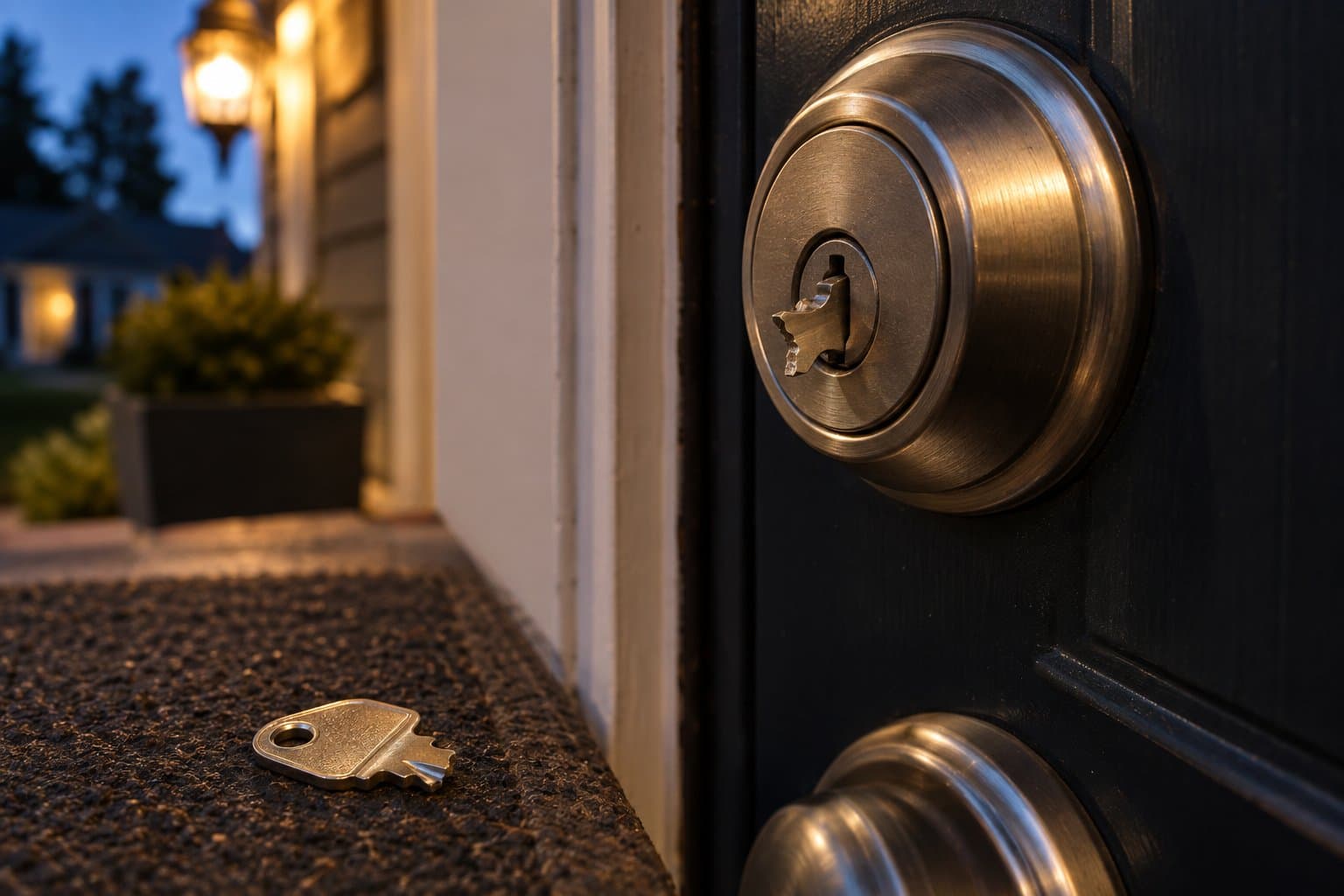
Key snapped off in the lock in Lakeland, FL
You turned the key and it broke. Half of it is in your hand and the rest is sitting in the keyway. The door may be locked, unlocked, or stuck halfway between. None of that is unusual, and in most cases the piece comes out and the lock carries on working. What decides it is what happens in the next few minutes.
Phones answered around the clock · free estimate
Lakeland sits inland in Central Florida, and the humidity here is high nearly year round. That moisture corrodes lock cylinders over time, and the same heat and damp swell wood doors and frames so the deadbolt binds against the strike plate. You end up turning harder every week without really noticing. Winters are mild, but the occasional light freeze and cold snap finishes off a cylinder that was already worn. Keys snap in cold weather and in worn cylinders, and a key that has been getting stiff for weeks was warning of exactly this.
While you wait — please don't
- Don't push the stub further in. Poking at it with another key or a pin usually drives the piece deeper and turns a simple extraction into a cylinder replacement.
- Don't use glue. Glue is what makes a lock unrecoverable, and then the whole cylinder has to come out and be replaced.
- Keep both broken halves. The surviving half is often enough to cut you a fresh key, so put it somewhere safe instead of binning it.
- Don't keep locking the door. If the door still works, leave it alone rather than testing it — a cylinder that has broken one key can break the next one while you are outside.
What the technician does
- Identification is checked firstThe locksmith will ask for identification and proof that you are entitled to enter the property or the vehicle before opening anything. Standard practice in Florida is photo ID plus something tying you to the address, such as a lease, deed or utility bill.
- You get the price before anything startsEvery job carries a free estimate. The locksmith gives you the price up front and you approve it before any work begins.
- The broken piece is extractedThe aim is to get the stub out of the keyway with the lock intact. That is the usual outcome when nothing has been forced in after it.
- The cylinder is checked and replaced if neededSometimes the keyway is chewed up and the cylinder is no longer reliable. In that case it is replaced rather than left to fail again.
- A new key is cutA fresh key can be cut from the surviving half, or from the lock itself if both pieces are too damaged to copy.
- The lock is lubricated and the door checkedThe cylinder is lubricated and the door alignment is checked, because a binding door is often what put the strain on the key in the first place.
Why this happens in Lakeland, FL
Lakeland's core is unusually old for Florida. Around Lake Morton, Dixieland and the Munn Park area you'll find 1920s land boom bungalows with original wood doors, and those doors move with the weather. Constant humidity encourages corrosion on hinges and lock cylinders, and swollen timber puts the deadbolt out of line with the strike plate. The key takes the load, and eventually one of them gives up.
Newer parts of the city behave differently but still wear out. The concrete block and stucco ranches from the 1950s to the 1980s around Cleveland Heights and Lake Gibson, and the post-2000 subdivision homes out toward Lakeland Highlands, Eaglebrooke and Christina, tend to have metal or fiberglass entry doors and attached garages, often inside HOA-governed communities with rules on door style and colour. Worn keys get copied, copies get thinner, and the thinnest one snaps. Lock work here runs all year rather than spiking with a first freeze, though volume rises with summer moving and rental turnover and again in winter when seasonal residents arrive.
Questions people ask
- Can the lock be saved, or do I need a new one?
- Often it can be saved. If the piece comes out cleanly and the keyway is undamaged, the lock is lubricated and stays in service. If the keyway is chewed, the cylinder is replaced and a new key cut for it.
- Both halves of my key are mangled. Can I still get a key?
- Yes. A key can be cut from the surviving half when it is usable, and from the lock itself when it is not. You do not need a working key to end up with one.
- My car key snapped in the ignition or door. Is that the same job?
- It is a related one, and automotive work is common in Florida. Many locksmiths cut and program transponder keys, proximity fobs and push-to-start smart keys, and they will typically ask for photo ID plus proof of ownership such as the title or registration.
- Are locksmiths licensed in Florida?
- Florida does not issue a statewide locksmith license and has no state locksmith licensing board. The trade is regulated at county or municipal level instead, and some jurisdictions have required local registration, permits or background checks. Rules change, so check current requirements with the county or city licensing or consumer protection office where the work is done.
- Do you cover the areas around Lakeland?
- One Call Locksmiths is a referral and scheduling service covering all fifty states. We arrange the work with independent locksmiths; we are not the locksmith and we do not do the work ourselves. Tell us where you are in Lakeland, or out toward Plant City, Auburndale, Winter Haven or Bartow, and we will arrange it.
One call
One call to (866) 690-5848 and we'll arrange a locksmith for your broken key in Lakeland. The estimate is free, and the price is given to you and approved before any work starts.
More from One Call Locksmiths
Nearby
Answers
Free tool
Something else in this area
- Locked out of the house
- Lost car key or fob
- Keys lost or stolen
- Business locked out
- Just moved in
- Lock is stuck or broken
- New or upgraded locks
One Call Locksmiths arranges the visit; the technician does the work and gives you the price.